Showing posts with label magic. Show all posts

Tuesday, March 25, 2014

The SM57 Transformerless Mod: You Know, The One Everyone Talks About But Nobody Posts Clips Of...

Sometimes you offer a friend or a client to do a project for them.  Then you put it off.  Then you forget about it (with the occasional "Yeah, I probably should get that done" reminder).  After about 5 of these, you have 40 hours of work to do and it all ironically ends up being due on the same weekend.  Such is life.

Rather than do the work.  I decided it was much better to procrastinate.  So I got out my soldering gun...

After patching up a few necessary things, I still had the itch to break stuff.  So I looked around the ol' man cave for something that I could tinker with and saw my pile of SM57's sitting in the corner.  I had read about this "transformerless" mod once or twice before, but I was never able to find any direct comparison videos/audio files.  So for fear of making a crappy mic sound worse, I never did it.  But procrastination was beckoning me and I couldn't refuse her sweet call.  It's a pretty rudimentary mod requiring little to no skill, so there's no need to assume I'm some sort of genius.

Basically, you disconnect the leads, boil the bottom to soften the glue (not the diaphragm!), pull out the transformer, reconnect the leads.  Done.  There are a bunch of videos/articles on how to do the mod, but for the sake of convenience, here's the one I watched:


Here's some photos of the mod taking place in my lab er... kitchen.


The transformer is covered in glue/plastic to hold it in place inside the microphone.
So when you yank it out, it looks like something birthed from an alien.
Once it was all put back together, I decided to test it out.  My chain was Tele w/ Lollar pickups > Vox AC15 > SM57's > 3124+.  I put the microphones right in front of the speaker cone pushed into the grill a little.  I call it my "Chris Walla" method.  (Though he didn't originate it by any means, he's known to do this frequently to get that speaker really in your face on records.)  I couldn't eliminate all the variables, but hey, what can you do?

**I'll tell you my opinions at the end, so you'll wanna listen to the samples first so your brain doesn't make predetermined assumptions.


I tried as best as I could to grab the exact same piece of air
with both mics.  The "T" is the mic with the mod.
Running into my API 3124+.  I matched levels as best as possible.  During the "Dirty" clips, I had to put the pad
on the standard SM57.  There's about a -10dB difference in the mic without the tranny.  **Ignore
what the blue tape says**
I used my EHX SuperEgo basically to send a fake "sine wave" into the amp so
I could match levels.  I didn't want one mic to sound better/worse because it was
louder or was clipping differently at the preamp.  I ran straight into the amp after
I got my levels.
Here are the results.  Pardon the shitty playing.  **FYI Soundcloud does compress, so if you're nitpicky you may want to download them instead of playing them through the player.


So what did you guys think?  Personally, I like both but for different applications.  To my ears, the mod rolled off some of the highs and there was slightly better bass response.  I think the modded 57 really improved the overdriven sounds, while the stock 57 won out for clean tones.  I will mention that I do like my clean tones a little jangly.  I did some reading and the mod is supposed to give the SM57 similar qualities to the SM7 (the two circuits are pretty much the same, or at least very similar).  I didn't have an SM7 on hand to compare it with, but it's something I'd like to do.

I must divulge and say that the SM57 definitely isn't my first choice for most things (especially guitar). But to most guitarists the words "guitar cab mic" is synonymous with "SM57".  I personally prefer the sound of a ribbon or a "better" dynamic over the 57 on amps.  However, it just has too many applications NOT to be used sometimes.  If you blend the brightness of a 57 with the darker ribbon mic, you can get a nice full bodied sound.  But it all depends on the guitar, amp, speaker, room, and personal taste.

Cheers!

-  Stonewall

Wednesday, February 12, 2014

Catching Ghosts Pt. 2: Gear is Like Porn for Nerds

*I'm going to jump right into the technical aspects of making the Bud Heavy album, so if you want a little background before I dive in click here.

I must admit, that I am a bit obsessed with making records in precarious places.  A little floor creak never ruined a record and frankly, it makes it more fun for me to listen to on the back end while I'm mixing.  And lordy did some yips, squeals, telephone dial tones, and ghosts get caught on tape (of course not literal tape).

The Room
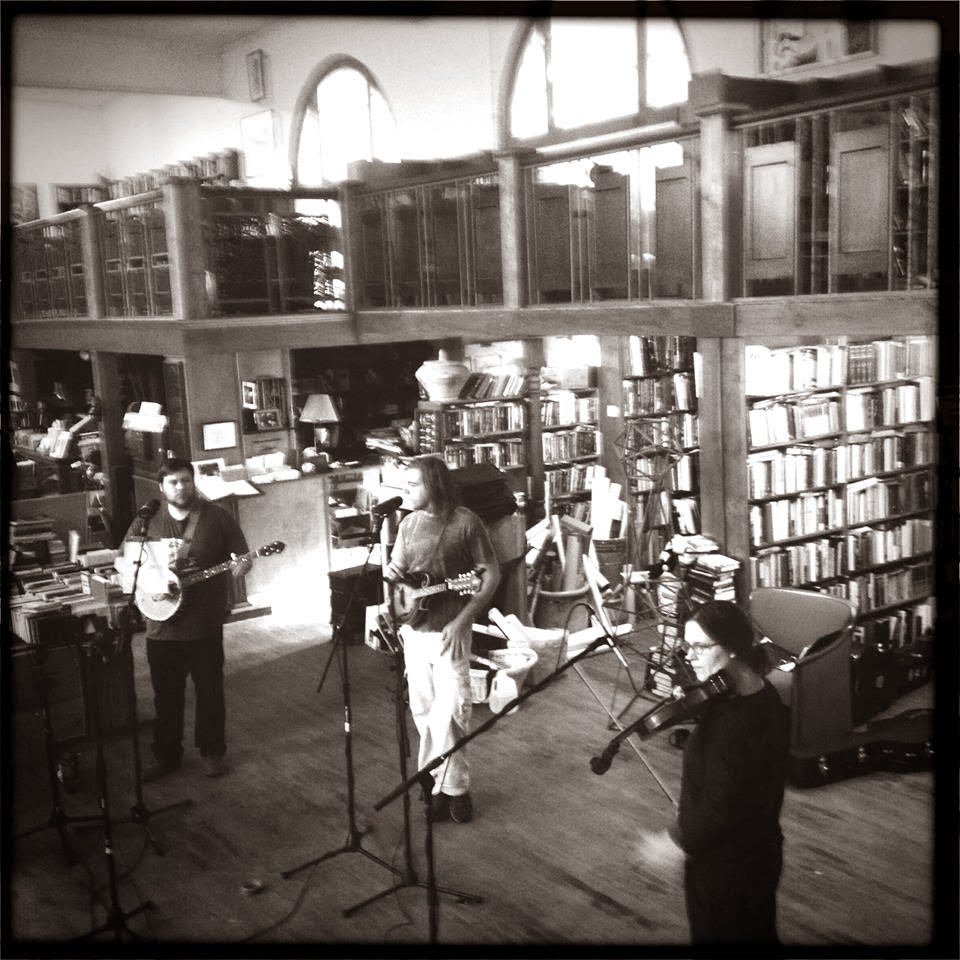
The Brownville Antiquarium has had many lives, but its current incarnation is that of a bookstore and art gallery.  Apart from the main room, there are a number smaller rooms (classrooms) filled wall to wall, floor to ceiling with books of every nature.  The main room is packed full of books, and I mean packed.  There's no space left on any bookshelf, and there are long wooden tables filled with even more literature.  It felt like every time I pulled a book off the shelf, a new book had annexed the space, leaving me feeling like an asshole with nowhere to return the book in my hands.

Credit:  Spencer Morrisey
The main room was originally the school gym, provided some nice wood floors for us to work with.  The second floor had been removed and now only a walkway about the perimeter still exists from that.  Normally, a room like this would provide almost unmanageable echo/reverb qualities.

But wait!  The books!

The books seemed to "soak up" a lot of that extra ambience.  Which is nice, because despite common trend, every song does not need to sounds like it's been bathed in a friggin' spring reverb tank.  The inlets of books and shelving also provided ghetto isolation booths if we needed it.

The Gear
Credit:  Maxwell Morrissey
At this point, some of the gear may elude me, but this is what we brought with us:
Mac Pro (SSD, lotsa Ram, Logic Pro 9 because Logic X blows)
RME Fireface 800 (Converters and "junk" preamps.  When you've got Neve, you use the Neve!)
Neze 1290 (x4 Neve 1073 preamp clones; thanks Ben!)
Ampex MX10 (x4 Channels of sweet RCA tube goodness, unfortunately it sums down to x2 outs, so we just used two of the 4 channels to prevent stuff from running over each other; thanks Mark!)
Yamaha HS8 pair (Monitors)

Mics:  AKG 414s, 451s, 112;  Audio Technica 4033, 4040;  Neumann TLM 103s; Cascade Fathead Ribbon;  Shure SM7b's;  EV RE20; various other dynamics and whatnots.  (Thanks Mark, Ben, Brad, and Chris!)

Recording Live aka What The Heck Is He Thinking
As I stated in the previous post, the goal was for this to be a very live feeling record.  On previous projects, I've isolated instruments and recorded in the standard scratch/overdub format.  Some have turned out great, some not so much.  However, Bud Heavy is a live band, so I wanted to capture what you would hear at a Bud Heavy show, but through headphones.  I'll write about a few difficulties we ran into doing it this way, but here was these basic signal path.  

*My engineer friend Mark did a lot of the legwork on this part, so please don't assume I deserve credit for everything.

Upright Bass:  RE20 > Ampex
Photo Credit:  Maxwell Morrissey

Placement:  I moved my head around to find the place where the bass sounded big, but not overly thumpy.  An upright can produce a heckuva lotta air, so I wanted to make sure I captured the full sound of the instrument, not just the BOOM!  Ultimately, I settled on about 6 - 8" from the bass, a couple inches about the bridge pointed between the strings and the F-hole.  That gave the musician a little bit of room to relax and not feel like he was glued to the mic.  Mark chose the Ampex (I think) for a nice warm tube sound, and we had the option of tube grit if we wanted it.

The upright was the only instrument we made use of our ghetto "iso booth" for.  We didn't want that low end to bleed all over the other stuff too much.

Guitar:  TLM103 > Ampex
Photo Credit:  Mark Hansen
Placement:  This took the most fiddling.  For the most part, the general placement was a couple inches away from the 12th fret pointing towards the sound hole.  It seemed like if we turned too much one way, we'd get lots of banjo bleed, and turning the other way would get bass bleed.  So we found a good balance and crossed our fingers.

*shrugs shoulders*  

I had a couple guitars with nice contrast to choose from:  my trusty Gibson Southern Jumbo and an old Gibson J45.  My SJ is one cannon of a guitar, while this particular J45 had a much softer sound.  With a bit of gain stage tweaking, I could easily swap guitars out for faster/slower songs.  I also used a crazy sounding Cigar Box guitar made by our Mandolin player, and a Nashville strung guitar was brought along, but never used.  Mark ran me through the Ampex again, for the same reasons as bass.  

Banjo:  AT4033 > 1073
Vocals:  SM7B > 1073
Placement:  Since the Banjo player was one of the lead vocalists, we tried our best to reduce the amount of bleed from the respective mics into the other.  As most people know, the SM7 has great rejection, so most of the time was spent with the banjo placement.  A banjo can produce quite a bit of power, and we had to be aware of the metallic sounds produced by the ring.  We found a spot where the sound of the banjo was full, but not boxy sounding a few inches back from the bottom left of the drum head.  

Mandolin:  AKG 451 > 1073
Vocals:  SM7B > 1073
Placement:  Most of the ideas from the banjo rang true for the Mando.  Again, the SM7B did a great job of isolation, although not as well as it did with the Banjo.  I wasn't involved with this placement as much, but in general the 451 was placed a few inches away from where the neck connects to the body facing back towards the F-hole.  Most likely to prevent the musician from swatting the mic with his hand while he played?

Fiddle:  Fathead II > 1073
Placement:  We tried a couple of different mics on the fiddle.  First the 451, but ultimately decided on the ribbon mic.  The ribbon mic resulted in a much warmer, sweeter sound.  Although a great mic, the 451 was too bright for our taste.  We put the Fathead up over the Fiddle player's left shoulder facing down and away from the Mando/Banjo.  As I listen back to the songs while I mix, the final fiddle sound has been my favorite overall.  


Room Mic #1:  414 > 1073
The 414 was flipped to Omni, and was about chest level in the center of the room, maybe 6-8' from the musicians.  
Room Mic #2:  TLM103 > 1073
This was put up in the air maybe 12', facing down towards the musicians about 15' away from them.
Wild Card:  451 > 1073
We stuck this puppy up near the ceiling and it had a pretty interesting result.  Lots of ambience!

Overall Impressions/Learning Points
I was very happy with all of the sounds we got.  While mixing, I have lots of options to choose from.  Room Mic #1 provides me with a type of "glue" while putting things together, and creates dimension in my mix.  My favorite sounds have been the fiddle mostly, and bass on a couple of the songs.  Not to say that the other instruments we done poorly, but those two were the ones that I notice made me start tapping my foot as I'm mixing.  

Recording live did not scare me from ever doing it again.  In fact, I'm pretty pumped to do more.  A few things I'd probably do differently next time:

1.  Use mics or outboard EQ that have a HPF on them.  Saves time doing this later on.
2.  A pair of outboard compressors.  I'm actually avoiding compression as much as possible in mixing, however, it would have been nice on the front end for vocals.
2.  Isolate "control room" better.  Mark had to get his gain stages set as best he could, while still being in the room with us.  What a champ!
3.  More time.  Our vocalists got pretty tired, and I don't blame them!  We also ran out of time for harmony vocals.  I don't feel like anything is lacking by any means.  There can always be more!
4.  This is a personal critique, but I wish I would have rehearsed more, primarily my harmony vocals.  I got too caught up in preparing the audio components for the recording that I didn't practice at home as much as I would have liked.  Oh well.  
5.  More whiskey....actually no, there was too much.


Whew!  Can't believe I typed all of that!

- Stonewall


Friday, August 9, 2013

Stonewall Approved Gadgets #1: Electro Harmonix Cathedral

Long ago, when Stonewall's Guide was still gestating within the folds of my brain, I decided that I wanted to provide a resource to fellow musicians/nerds, without having to ball gag everyone with the latest hype and trends that plagues the forums.  Like music, I like to create things I would want to hear/read.  There's nothing more worthless to me, than reading a review about a pedal, which the writer has owned for three days, and ultimately claims "X pedal is the best thing they've ever heard."  If this is the case, you were probably born yesterday.  Tastes change, you get interested in other music, yada yada.  So I'm creating an installment, if you will, where I'll highlight some of my favorite pieces of gear that I'm particularly attached to.  Most of it, I've had for a decent amount of time and still use fairly regularly.  Since I don't get any free gear via sponsorship, I can give an honest pro/con.  I hate the term "review", because that gives off the vibe that I plugged it in for a couple days and formed some silly opinion, rather than really putting something through the gauntlet.  So welcome to the first feature of Stonewall's Approved Gadgets.

I'd like to kick this off regarding a very popular item these days, the reverb pedal.  It seems to be an ever increasing trend of buying/selling/trading reverb units, to get that latest "Shimmer" or "Grandma's Bathroom" reverb sound.  Prices on these puppies are getting higher and higher too (Blue Sky $300, Space $500).  To me though, most reverbs are just boring as F%&$.  (*turns knobs* big space *turns knobs* little space)  I'm still trying to wrap my head around why everyone wants a dedicated modulated reverb (I do have a deep hatred for most Flanger sounds).  I have two requirements that I look for in modern reverbs, decent plate sound and on subtle reverbs, the effect doesn't wash out when a boost is engaged.  I don't know why, but most companies never get the latter requirement right.  Any other added features outside of those requirements I just consider a bonus.  I used to just resort to using amp reverb, which I sometimes forget to shut on and off for various songs during shows, and is a pain.  I also don't want to deal with extra cables from FX loops and footswitches.  Solution?

Electro Harmonix Cathedral


 I will start by saying no, this is not the greatest reverb ever.  But damn, it is cool.  I'm not going to explain what all the knobs do, you're a big kid, but let me give you the basics.  It does 7 different types of reverb that you can save one preset for each type, and an echo.  The "Infinite", is a momentary switch that will hold sound that it captures when you hit the switch until you let it go.  Sort of like the Freeze/Slow Gear pedal, but very different.

Pros

An old pedalboard shot from a short tour I did.
Obviously, I like this pedal because it covers my two requirements.  The Plate setting is very big sounding, which I love for that droney shit.  And on most of the reverb types, it doesn't wash out.  The Plate will wash, but that's just what happens with real Plate reverb anyways.  As long as I have one other type of small reverb sound to emulate amp reverb (knob set to maybe 1-2), I'm happy.  Most people use too much reverb, I like it subtle.  The Room setting does a good job of that.

Added bonuses:  Cheaper than most reverbs.  I think it's maybe $220 street price?  Snag one used for $150 and you're set.  That's the price of the ever-so-popular RV5, and unlike the RV5, it doesn't sound like crap.  Presets?  Awesome.  It's nice to be able to just save a couple different 'verbs and recall them quickly.  I'm lazy.  Having an extra delay is nice too.  It'll sort of (I say sort of, and I'll address that in the Cons) of knock out the need to have a simple digital delay on your board for long repeats.  The Reverse doesn't really work like how a Reverse Delay would, but I actually use this a lot for a long, 90% wet, droning sound.  Very This Will Destroy You sounding.

The "Infinite" feature is definitely my favorite bonus.  I own a Freeze and Superego, and I must say, I really like the way this "freezes" the sound more.  A)  It swells into the freeze, rather than lock it in right away.  Sounds more natural to my ears.  B)  You can use the momentary switch to control how fast you want to release, by repeatedly releasing the switch for a couple moments at a time.  Like easing on the break in a car.  Again, more natural sounding than just killing the sound.  

The pedal is also built like a tank.  Which is actually pretty strange, because I've had a number of build issues with EHX stuff before.  This pedal has seen tons of shows, and I've even dropped it a couple times (yeah, like you've never done that).  Still works great.  As lame as this sounds, the graphic is pretty cool too.  

Cons

Since the goal isn't for me to gloss over the nasty stuff, here are a number of things that I wish could be improved about this pedal.  It's got the old Holy Grail algorithm as one of the preset types.  Which means all the old problems the Holy Grail had such as, being useless after 12 o' clock, volume drop, etc.  Again, some of the reverb types will wash out, which is really frustrating.  It basically means I can't use that reverb unless I don't anticipate doing any sort of gain staging.  But like I said, a majority of reverbs have this problem so I just choose to deal with it on this specific unit.  There's also a slight volume dip on a couple reverbs, especially the Accu Spring.  

As I eluded to before, the Echo is nice, but isn't very good.  For some reason it doesn't "cut through" very well.  I had heard about delays having this issue, but I've never really had this problem with any of the ones I owned, so it was very noticeable discovery for me.  Even if you turn the Blend (aka Depth) way up, it seems to duck out regardless.  I don't really use the delay much due to this (not that I really needed another delay).  
My final real complaint is that the white selector knob can be a bit sensitive.  Meaning if you're playing a show and the pedal is bumped too hard, it'll bypass your preset to whatever the knobs are at.  I end up just taping it down.  Not really a big issue, you just have to watch out for it.  

Improvements?

The last two "issues" I'll talk about, are more recommendations than cons.  I wish this pedal (actually any reverb) had a spillover circuit.  I'd like to turn it off and have the sound decay out naturally vs. stopping abruptly.  I actually have a looper on my board, just so I can sample short segments of this, and slowly fade it out, cause of this problem (some delays do this too).  I know that would require the pedal to "lose" its True-Bypass, but you're a child if you really believe all of your pedals need to be True Bypass.

Also, it would be super amazing if someone (Walrus audio?) offered a mod, so you could have an expression pedal control the "Infinite" function.  That way you could control the swell in and out better.  Not necessary but it'd be convenient.  


Anyways.  There are so many cool usable things about this pedal that I just love.  I've had since it came out, and I've used it on everything I've done ever since.  I think I tried to sell it once, but I put it at a stupid high price so no one would buy it (a big indicator that you really don't want to let something go).  I don't really care whether it has a Shimmer effect or not.  I tried a pedal with them shimmers, and I could never really use that sound in a musical context (it's harder than you think without sounding cheesy).  I've never been so blown away by more expensive pedals that I've felt the need to make an "upgrade".  If you're selling a $500 reverb, it should sound/have features that are $300 better than my $200 reverb.  I'm intrigued by the Eventide space, but it's way too much to shell out for.  So I just stick with what works.

- Stonewall

Friday, June 14, 2013

"Studios"

I wish I was one of those people who could sit on a couch like a lethargic puddle of human existence.  I could pass my days away soaking in sitcoms, eating Bugles, and cleaning my belly button out at various points in the day.  But alas, I fall into the category of animal whose brain doesn't shut down, because every second must be injected with tedious work.  In a way, time has become my nemesis.  As soon as I wrap up a project, another much larger one looms in the distance.  More specifically, I have finally gathered the final pieces for my Guild S-100 project, and now I am left scratching my head on how to even approach my next assignment:  upgrading my "studio".

Before I get much into my project "studio", allow me to digress since studio related things have been the only thing on my mind as of late.  Since the innovation of computer recording, everyone thinks they are a "producer" or "audio engineer" these days.  When I worked music retail, I can't even begin to tell you the number of people who came in asking me how to "set up a studio so I can make beats with Fruity Loops".  Atrocious.  A woman I almost dated (during a time of extremely low self-esteem and chronic beer goggles), had once told me her ex had even owned a studio.  I soon discovered that this "studio" was merely a Behringer mixing board, hooked up to a couple of crappy computer speakers, with a computer patched into the board.  90% of these people who buy an MBox end up having it sit around because they are either too lazy, or much too dense to even try to learn to use it.  The other 10%, end up with shotty recordings and give it up.  Then there are the few, like myself, who wonder if we can actually try to make a decent recording.  Over the past 4-5 years I have become increasingly interested in building my own project "studio".  I use the term "studio" very lightly, because any real audio engineer would scoff at my over-glorified Mancave.  However, since I am not a neanderthal with a BR600, I am comfortable saying I have a project "studio".

I will say that I do not have any fantasies about becoming a world famous engineer/producer.  And I have no intention of expanding into a larger commercial outlet.  I mainly use my cave to get simple ideas down, track a few guitar/bass/piano sounds, and do a bit of arranging, do a demo for a friend.  But most importantly, progressively improve my sound. There are legitimate studios for more complex things (notice the " " is gone?).  Real studios have Telefunkens, Neumanns, UA compressors, and Neve consoles (whose recording prowess can only be attributed to the evil Ganondorf sealed away forever within the board).  If you're looking to record something serious, an album, single, soundtrack, or whatever, it's much smarter to invest your money somewhere where you can worry about the music, and they can worry about the sound.  I'm not trying to scare anybody, but it's much smarter to think about where you're investing a few thousand dollars before you do.  Yourself or a studio?  If you do build a studio, narrow it down to what you want to do with it. 

Anyhow.  The first and most important thing in a studio, even more so than gear and the engineer, is the room which you record and mix in.  Blows your mind doesn't it?  Blew mine at least.  The room is crucial because it's what reflects the sounds and noises that happen in the room.  Corners can suck up all of your bass, footsteps can bleed onto mics, and you can even get a false perception of a mix in a bad room.  So it's extremely important to "treat" your room.  And when I say "treat", I'm not talking about sound proofing the room so sound can't get out, I'm talking about controlling the frequencies within the room.  To be honest, I can give much advice here as of yet.  If you can afford it, have someone do it for you.  Due to my budget (or lack thereof), I can't afford to have someone plaster my walls in Auralex and pretty panels.  So, much of my "new" room will be very DIY.  I'll be taking photos and keeping you in the loop as I go about this process, and how to be a cheapass doing it.  Here is the room I will be working with:

The best thing to do is get someone's advice on where to start.  I've been poking around on a few forums and getting some ideas, but I ran across this.  You can send your room measurements to one of these big box online distributors and have them do all the planning for you.  Then instead of buying the expensive traps from them, I'll build the ones I can.  No, my room will not be perfect.  But I'm not recording drums or doing any epic live orchestration.  And if you look, concrete and plywood walls aren't that great either.  I'm just trying to make the best of what I have to work with.  I'll talk more about my game plan, gear, and provide a photo blog of the final S-100 project soon.

Cheers!

-  Stonewall

Thursday, June 6, 2013

A Tribute to a Friend Passed: The DL4 Still Slays

Reality is sad, sad indeed.  Sad, because I'm about to blog about my sense of loss over material possessions.  Sad, because you're going to read this pathetic post.  But what's most sad, is my long lived Line 6 DL4 has kicked the bucket.  That big green echo monster was my baby, I've had it for 9+ years now.  There are many magic spaceship delays out there right now, and I'm sure there are some that make glitter and unicorns shoot out of your guitar's headstock, but the DL4 was my favorite delay.

I remember getting into guitar gadgets when I was a meaty, sweaty, angsty high school kid.  This mysterious emerald device kept showing up on pedalboards of my favorite guitarists.
Aaron Pill of The Appleseed Cast.  One of my favorite guitarists.
This photo's pretty damn old too.
I probably watched hundreds of YouTube videos about the pedal.  I had to have it...so the antagonizing began.  I was relentless and I never stopped talking my mother into buying it for me.  After over a year of unsuccessful murder attempts my mom plotted against me, she finally had to cave.  On Christmas morn, the glorious DL4 became mine.  Oh the delight I had in twirling its knobs, making whale sounds, and creating god awful feedback!  I used it in every band I've ever played in.  At one point (during a heavy Minus the Bear phase) I had borrowed a second one and had both on my board.

No.  The DL4 does not have the best sounding delay, nor the best features, and there are little annoyances (like the ever-so-common volume drop issue).  I love my DM3, Moog 104M, and I loved my DMM (before Howard Davis f*&#ed me over).  But like these other famous units, nothing else sounds quite like it.  It's not a pristine clean sounding digital delay, it has some quirks.  However, I've had phases where I just flat out didn't want to use it anymore because it was "outdated", I didn't have the $$$ to mod it, or other various pathetic excuses.  The Line 6 M series spaceships came out, promising all of the features of the DL4 but better!  I quickly acquired these devices, hoping they'd knock my DL4 out of the park and provide me with more shit I didn't need.  I've bought and sold both the M13 and M9 on at least two occasions.  They just didn't sound right to me.  They were "too perfect".  The Reverse and Auto Volume didn't sound right, and the new M Series Analog Delay setting didn't sound as dark as my DL4.  The Eventide and Strymon fads have come, and will go.  I've considered "upgrading" on multiple occasions.  Prior to my current debacle, these new units never really offered more realistically usable features than the DL4 did.  

My DL4 had burnt out once previously.  I used it for 8 years, then randomly it farted out last year.  The local prick who fixed it says I was using a "questionable means" to power it (One Spot + L6 Adapter = questionable?  Probably not).  $80 repair.  Pretty hefty cost since you can get them secondhand for well under $150 now.  But hey, it has sentimental value.  A couple weeks ago, I decided to bust it out again.  Plugged it in.  Lights came on.  Abnormally flashed a few times.  Then nothing.  I tried different cables.  I double checked the owners manual to my new power supply I've bought since the last burnout.  I tried a different power supply.  Nothing.  I've read on all the forums about static under the chip, hard resets, yada yada.  I've tried it all, it's toast.  I'm well beyond my warranty on it.  Another $80 doesn't sound too appealing.  So I feel like it's time to retire it.  (Unless someone wants to fix it up free :D  )  

Now I'm in a weird situation I haven't been in for years, what's going to replace it?  Not sure I want a second one yet.  It's like being single after a long relationship, except the end result will have less Crabs.

R.I.P. my little green friend.


-  Stonewall